 BEA Summit is Live
BEA Summit is Live
BEA Summit is Live
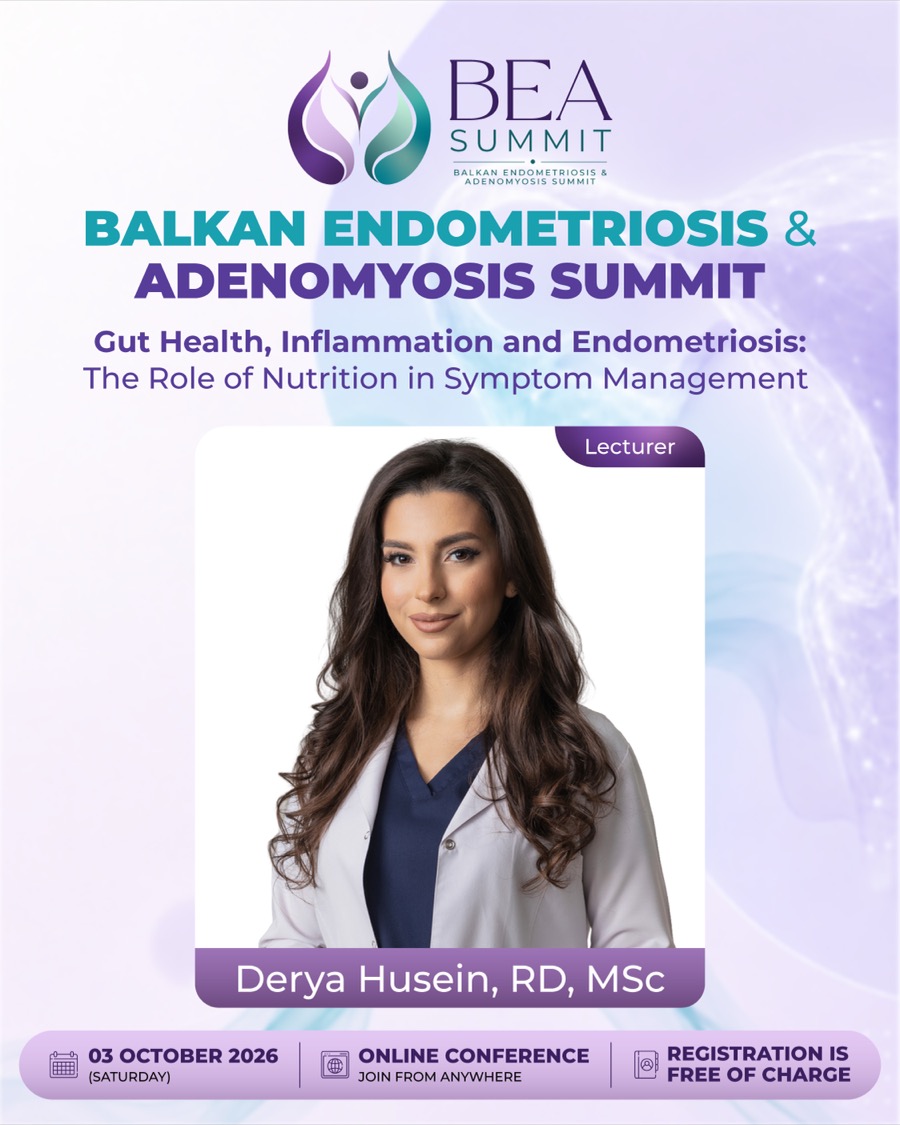
Derya Husein is a clinical dietitian registered with the HCPC whose work combines medical nutrition, women’s health, and public health education. She holds a master’s degree from Robert Gordon University and has extensive clinical experience from hospitals in Glasgow, where she worked with patients in gastroenterology, endocrinology, oncology, and complex medical cases. Her professional interests include endometriosis, PCOS, gut health, the microbiome, metabolic and endocrine disorders, as well as nutritional support before and after surgery; her experience also encompasses enteral and parenteral nutrition. She is the founder of DietitianMED, actively educates patients and professionals, participates in international organizations such as ESPEN and the BDA, and is known to a wide Bulgarian audience from the show “Life on the Scale,” where she presents a practical, science-based approach to nutrition and the microbiome.
On 3 October 2026, Dr Husein will join the Balkan Endometriosis & Adenomyosis Summit 2026 - a free, online conference in English bringing together leading specialists and patient organisations from across the region.
The conversation with Derya Hüseyin explores how her experience at major hospitals in Glasgow and the women’s health professionals’ movement in the United Kingdom have shaped her approach to women’s health, early diagnosis, and compassionate clinical care. She explains how her practice has naturally focused on endometriosis, PCOS, metabolic disorders, and gut health, guided by the real needs of her patients and the complex connections between hormones, metabolism, and microbiome. The interview highlights the importance of a varied diet, critical thinking regarding online advice, and the role of personalized, evidence-based nutrition in preparing for surgery, recovery, and the long-term management of chronic conditions.
This is a very interesting question, and I don’t think I can fully answer it, because ultimately I believe women are women everywhere, and across the globe they deserve the same empathy, respect and quality of care.
If there is one thing I would highlight from my experience in the UK, however, it is the growing and very powerful movement of female-led healthcare professionals, clinicians and advocates who are actively identifying and addressing gaps in women’s health. I could feel this particularly during my time working at Queen Elizabeth University Hospital and more broadly through my experience working across the UK. There is a strong willingness to challenge what has traditionally been accepted as “normal” for women and to push for better recognition, earlier diagnosis and more personalised care.
One development that I find particularly encouraging is the progress being made around endometriosis diagnosis. In 2026, NICE issued draft early-use guidance supporting the use of new non-invasive technologies in the NHS while further evidence is generated. One of these is Endotest, a saliva-based test that analyses microRNAs - small biological markers that can indicate whether endometriosis is likely to be present. It has the potential to help shorten the diagnostic journey for women who have historically faced years of uncertainty and, in some cases, dismissal of their symptoms. This is particularly significant given that the current average time to an endometriosis diagnosis in the UK is around nine years and four months, with even longer delays reported among women from ethnically diverse communities.
For me, this is an example of what can happen when clinical expertise, research, innovation and women's voices come together. It makes me proud to have worked within the UK healthcare system and to see women’s health increasingly being treated as a priority rather than an afterthought. At the same time, I think there is still a long way to go globally, and the UK’s experience can hopefully contribute to a much wider conversation about how we listen to women, recognise their symptoms and design healthcare systems around their actual needs.
To be completely honest, I never initially set out for women’s health to become one of my main areas of interest. Earlier in my career, I was particularly passionate about oncology, and that was where I originally saw myself developing my expertise.
However, as my clinical practice evolved and I began working with a much broader range of patients, my areas of interest naturally started to shift in response to what I was seeing in front of me. Approximately 75–80% of my patients have been women, particularly within my weight-management practice, and I was increasingly encountering women presenting with complex and interconnected concerns such as PCOS, metabolic dysfunction, gastrointestinal symptoms and difficulties with weight management.
What really changed my perspective was recognising that these conditions rarely exist in isolation. The conversations around weight, hormones, metabolic health, gut health and reproductive health were often deeply interconnected, and I found that my patients were asking questions that required me to look beyond a single diagnosis or a conventional nutrition intervention.
In many ways, the needs of my patients became the driver of my professional development. The more frequently I encountered these conditions, the more I felt a responsibility to understand them properly. This led me to actively seek additional education, read more extensively, undertake further professional development and gradually build greater expertise in these areas.
I believe that, as specialists, our learning should not be driven solely by what we find interesting, but also by what our patients genuinely need from us. In my case, my clinical practice was very clearly telling me where those gaps were. PCOS, metabolic health, gastrointestinal health and weight management became recurring themes in my practice, and that demand naturally pushed me to deepen my knowledge and develop a more specialised approach.
What began as a response to my patients’ needs has therefore evolved into a genuine professional interest. It has also reinforced something I strongly believe in as a dietitian: good clinical practice requires us to remain curious, responsive and willing to keep learning as our patients and the evidence evolve.
I think the biggest misunderstanding is that people see fibre as one single nutrient and believe that simply taking a fibre supplement is enough to support their gut microbiome. In reality, different types of fibre feed different groups of gut bacteria, so variety matters. A diverse diet - bringing in vegetables, fruits, wholegrains, legumes, nuts and seeds - provides a much broader range of fibres and plant compounds that can support a more diverse and resilient microbiome.
I also remind patients that more is not always better, especially if increased too quickly. The goal is to gradually increase fibre while also maintaining good hydration and overall food variety. Rather than focusing on one “superfood” or probiotic product, I encourage patients to think about the bigger picture: eat a wider variety of plant foods, introduce fibre gradually, and make it a sustainable part of everyday eating.
I always encourage patients to be curious rather than fearful of food. There is an enormous amount of nutrition advice online, and much of it is presented with confidence but without strong evidence behind it. I help patients look beyond headlines and ask simple questions: Who is giving this advice? What evidence supports it? Is it relevant to me? We then focus on what the evidence actually tells us, rather than following trends, fear-based messages or unnecessary restrictions.
Most importantly, I try to make evidence-based nutrition practical. Patients do not need a perfect diet or a list of foods they are “allowed” or “not allowed” to eat. They need realistic strategies that fit their lifestyle, culture and health goals. My role is to give them the knowledge and confidence to make informed choices, so they can eventually navigate nutrition information independently rather than feeling overwhelmed by every new trend they see online.
For women with complex conditions such as endometriosis or PCOS, the main goal of perioperative nutrition is to prepare the body for surgery and support recovery afterward. I focus on adequate energy and protein intake, maintaining muscle mass, supporting immune function and ensuring key micronutrient needs are met. It is also important to address symptoms such as bloating, constipation or gastrointestinal discomfort where appropriate, while avoiding unnecessary restrictive diets that could compromise nutritional status before surgery.
After surgery, the focus shifts towards healing, rebuilding strength and gradually returning to normal eating. I tailor the approach to the individual, considering their symptoms, metabolic health, medications, activity levels and recovery. For me, perioperative nutrition is not about achieving a particular weight before surgery - it is about ensuring women are nutritionally prepared, supported through recovery and given practical strategies that promote long-term health.
I founded DietitianMED because I saw a clear gap between the amount of nutrition information available and the quality of nutrition guidance people actually receive. Patients are often exposed to conflicting advice online, restrictive diets and misinformation, while at the same time struggling to understand how nutrition connects with conditions. I wanted to create a platform where evidence-based dietetic care could be communicated in a way that was practical, accessible and genuinely relevant to people’s lives.
I also felt there was a gap in communication between healthcare professionals and the public. Good clinical knowledge only has an impact when people can understand it and know how to apply it. DietitianMED was therefore created to bring together clinical expertise, education and public communication - to give patients access to trusted professionals while also helping translate complex health information into clear, practical messages. Ultimately, the aim is to empower people to make informed decisions about their health rather than feel overwhelmed by the constant stream of nutrition advice.
My experience as the clinical dietitian in the first season of The Biggest Loser in Bulgaria taught me that metabolic health cannot be addressed by one discipline alone. Working alongside physicians, psychologists, trainers and the wider team showed me how important it is to bring different areas of expertise together when supporting people living with obesity and complex health needs. It also taught me that obesity is never simply a story about food or willpower. Behind a person’s weight there is often a much more complex story - of biology, emotions, environment, habits, previous experiences and sometimes years of being misunderstood or judged.
One of the most important lessons was that knowing what to eat does not necessarily mean knowing how to change your relationship with food. Many people living with obesity already know far more about diets than we might assume; what they often need is help understanding why previous approaches have not worked for them and how to build sustainable behaviours without shame or extremes. This experience reinforced my belief that our role as healthcare professionals is not simply to give people more nutritional information, but to help them turn knowledge into confidence, realistic action and long-term change. Ultimately, multidisciplinary care works best when we treat the person, not just the weight.
I expect the next decade to bring a much more personalised and integrated approach to women’s health nutrition. We are learning more about the complex relationship between nutrition, the gut microbiome, immune function, inflammation, metabolic health and reproductive hormones, but I think the most important development will be moving from interesting associations to robust clinical evidence that can genuinely guide practice. The gut, in particular, remains one of the most challenging areas of nutrition research because the microbiome is extraordinarily dynamic and individual. There is no single “healthy microbiome” and, in practical terms, no two people have exactly the same microbial ecosystem. It is influenced by diet, geography, medications, age, lifestyle, health status and many other factors, making it extremely difficult to isolate cause and effect. We also need to distinguish between an association observed in microbiome research and an intervention that has been proven to produce a meaningful clinical outcome.
For that reason, I hope the next decade brings not only better research methodologies and larger, longitudinal studies, but also patience from both the public and our fellow healthcare professionals while that evidence is being built. There is understandably a desire for immediate answers, particularly among women living with chronic conditions, but science needs time to collect, reproduce and validate data. I would hate for promising early research on the microbiome to become another source of nutritional fear or overly restrictive advice. The future of women’s health nutrition, in my view, is about becoming more precise without becoming more prescriptive: understanding the individual woman, interpreting emerging evidence critically, and translating genuinely robust findings into practical care while being honest about what we still do not know.
Register free to attend Derya Husein, RD, MSc’s session and the full BEA Summit 2026 programme.
Register Now