 BEA Summit is Live
BEA Summit is Live
BEA Summit is Live
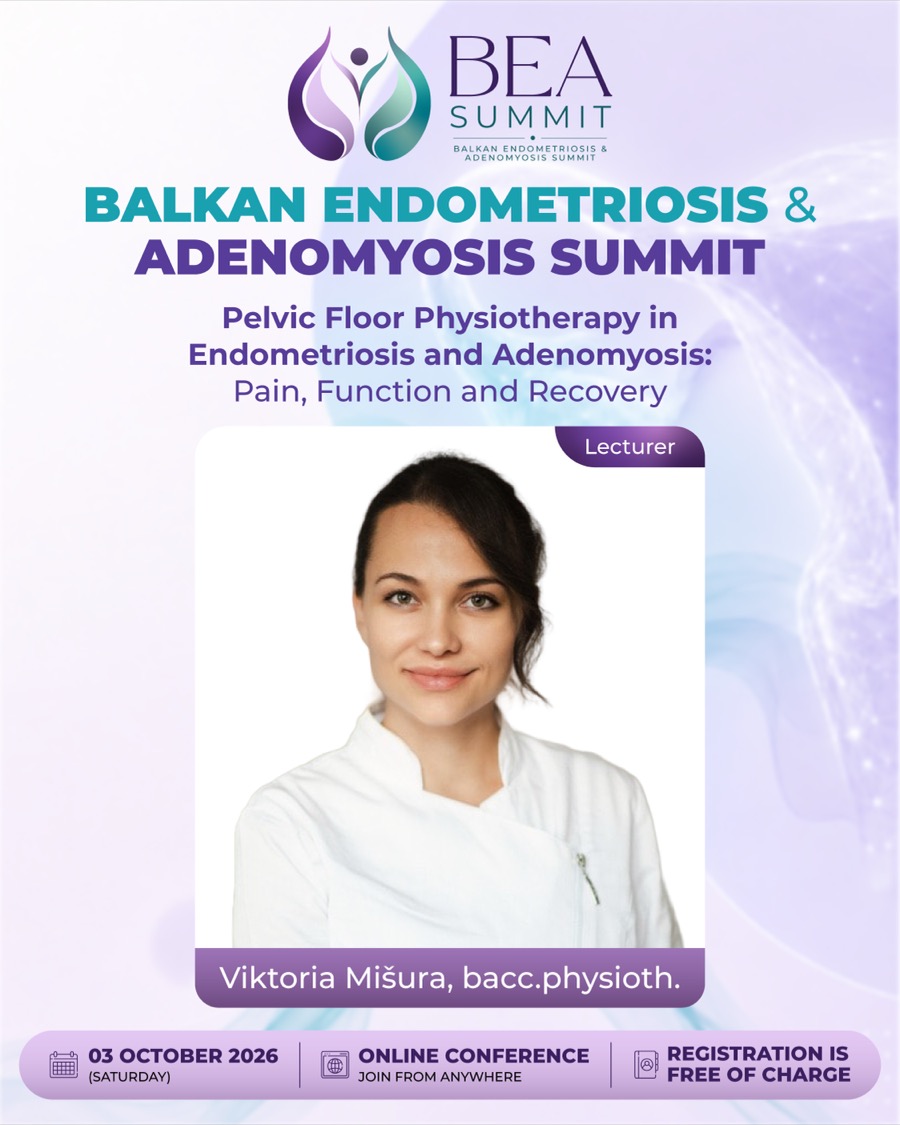
Dr. Viktorija Mišura is a physical therapist and osteopath from Zagreb who specializes in pelvic health, chronic pelvic pain, and physical therapy for women’s health conditions. She has over ten years of clinical experience and extensive postgraduate training, ranging from pelvic floor rehabilitation and prenatal/postnatal physical therapy to myofascial techniques, neuromodulation, and NeuroKinetic Therapy. Since 2023, she has been running her own practice, where she works with women with endometriosis and adenomyosis, combining pelvic floor assessment, manual techniques, movement, and individualized exercises to reduce pain and improve function. She actively participates in educational initiatives and serves as a professional associate of the Croatian Endometriosis Association, promoting the role of physical therapy in modern women’s healthcare.
On 3 October 2026, Dr. Misura will join the Balkan Endometriosis & Adenomyosis Summit 2026 - a free, online conference in English bringing together leading specialists and patient organisations from across the region.
The conversation with Dr. Mišura explores how her interest in pelvic health and osteopathy led her to work with patients suffering from chronic pelvic pain and endometriosis. She explains how physical therapy and osteopathy can alleviate the musculoskeletal effects of the condition, reduce pain, and improve function through a combination of manual techniques, movement, and individualized exercises. The interview also outlines the future of this care—earlier involvement of physical therapists in multidisciplinary teams and the development of specialized approaches for endometriosis and adenomyosis.
My interest in pelvic health began during my physiotherapy studies. At that time, I became very interested in gynaecology, urology, and obstetrics, particularly because I started to understand just how many different ways physiotherapists can contribute in these areas and how much we can actually do to help patients.
That really fascinated and intrigued me. Later, through clinical practice and my professional work, I realised that I genuinely enjoyed working with both women and men with pelvic health problems and chronic pelvic pain. I found this field especially interesting because these conditions are often complex and require a broader understanding of the patient and their symptoms.
I also became increasingly aware that pelvic health physiotherapy is still not sufficiently developed in our region. There are many patients who could benefit from this kind of approach, and I believe physiotherapists can make a very meaningful difference in their recovery, function, and quality of life.
What really drew me more deeply into endometriosis was the experience of a close friend who has the condition. Through her, I was able to hear first-hand what living with endometriosis can actually feel like, and one word kept coming up again and again- pain.
Pain is also one of the main reasons people seek physiotherapy, so that naturally made me question how we, as physiotherapists, could specifically help women with endometriosis and what was actually happening in their bodies.
At the same time, because of my osteopathic background, I was also looking at these patients from an osteopathic perspective. That became very important to me, because osteopathy allows us to look at the body more globally and to consider the relationships between different systems, rather than focusing only on the area where the pain is felt.
As I researched endometriosis more deeply, I became increasingly aware of how significantly it can affect the musculoskeletal system, and how those secondary changes can themselves become a source of pain, restriction, and dysfunction. This is where I began to see how both physiotherapy and osteopathy can have an important role in supporting these women, not by treating the endometriosis itself, but by addressing many of the functional consequences associated with it and helping to improve movement, symptoms, and quality of life.
What surprised me most was just how profound endometriosis can affect the musculoskeletal system. It is not only a gynaecological condition — it can be associated with adhesions, increased muscular tension, restricted mobility, altered movement patterns, and increased sensitivity of the nervous system, all of which can contribute to pain and dysfunction.
What I found particularly interesting was how many of these areas can be addressed through an osteopathic approach. By looking at the body as a whole and working with musculoskeletal restrictions, tissue mobility, muscular tension, and the nervous system, we may be able to reduce some of the secondary dysfunction associated with endometriosis and help patients manage their symptoms more effectively.
For me, that was one of the most important findings — understanding how much the condition affects the body beyond the reproductive system, and how much potential there is for osteopathy to support these women alongside their medical treatment.
The pattern I most commonly observe is increased tension or overactivity of the pelvic floor muscles. It is certainly not present in every patient, but it is very common among women with chronic pelvic pain, often together with a range of additional symptoms.
What is important is that the pelvic floor is not always weak, as is often assumed. In many women with chronic pelvic pain, the problem is actually excessive muscle tension and difficulty relaxing the pelvic floor, which can itself contribute to persistent symptoms.
Definitely the role of exercise. Patients often underestimate how much appropriately selected, individualized exercises can contribute to reducing symptoms, improving function, and ultimately improving their overall quality of life.
What often surprises them most is the difference they can achieve when they are patient and consistent with the exercises over time. It is not always an immediate change, but with regular practice, many patients begin to notice significant improvements.
I think one of the biggest misconceptions is that physiotherapy has little or no role in endometriosis simply because it is primarily regarded as a gynaecological condition.
If someone has an injury or dysfunction of the musculoskeletal system, it is almost automatically understood that physiotherapy may be needed. But with endometriosis, that same logic is often not applied, even though the condition can significantly affect muscle tension, mobility, movement patterns, pain and overall physical function.
For me, this is exactly where the perspective needs to change. Physiotherapy and osteopathy should be recognised as valuable components of a multidisciplinary approach. We are not treating the endometriosis itself, but we can address many of the functional consequences that contribute to pain and reduced quality of life.
Working independently has given me the freedom to focus on the type of patients and clinical areas I am most interested in. It also allows me to work in a much more individualised way and to dedicate more time and attention to each person.
I can adapt the treatment plan more closely to the patient’s specific needs, symptoms, lifestyle, and goals, rather than following a more standardised approach. For me, that flexibility and the possibility of creating a truly personalised therapeutic process is one of the biggest advantages of working independently.
I think the greatest potential is in bringing physiotherapy and osteopathy much earlier into the care of women with endometriosis and adenomyosis.
Too often, women reach physiotherapy or osteopathic care only after they have been living with pain and other symptoms for years. I would like to see these approaches becoming part of the multidisciplinary team much earlier, not only when symptoms become severe, but also in supporting movement, pelvic floor function, recovery, and quality of life from the beginning.
I also think there is a lot of potential in developing more specific physiotherapy and osteopathic approaches and in conducting more research in this area. We still have a lot to learn about which interventions work best for different patients and at different stages of their care.
For me, the biggest step forward would be for physiotherapy and osteopathy to become recognised and expected parts of endometriosis and adenomyosis care, rather than something women discover only later on.
Register free to attend Viktoria Mišura, bacc.physioth.’s session and the full BEA Summit 2026 programme.
Register Now