 BEA Summit is Live
BEA Summit is Live
BEA Summit is Live
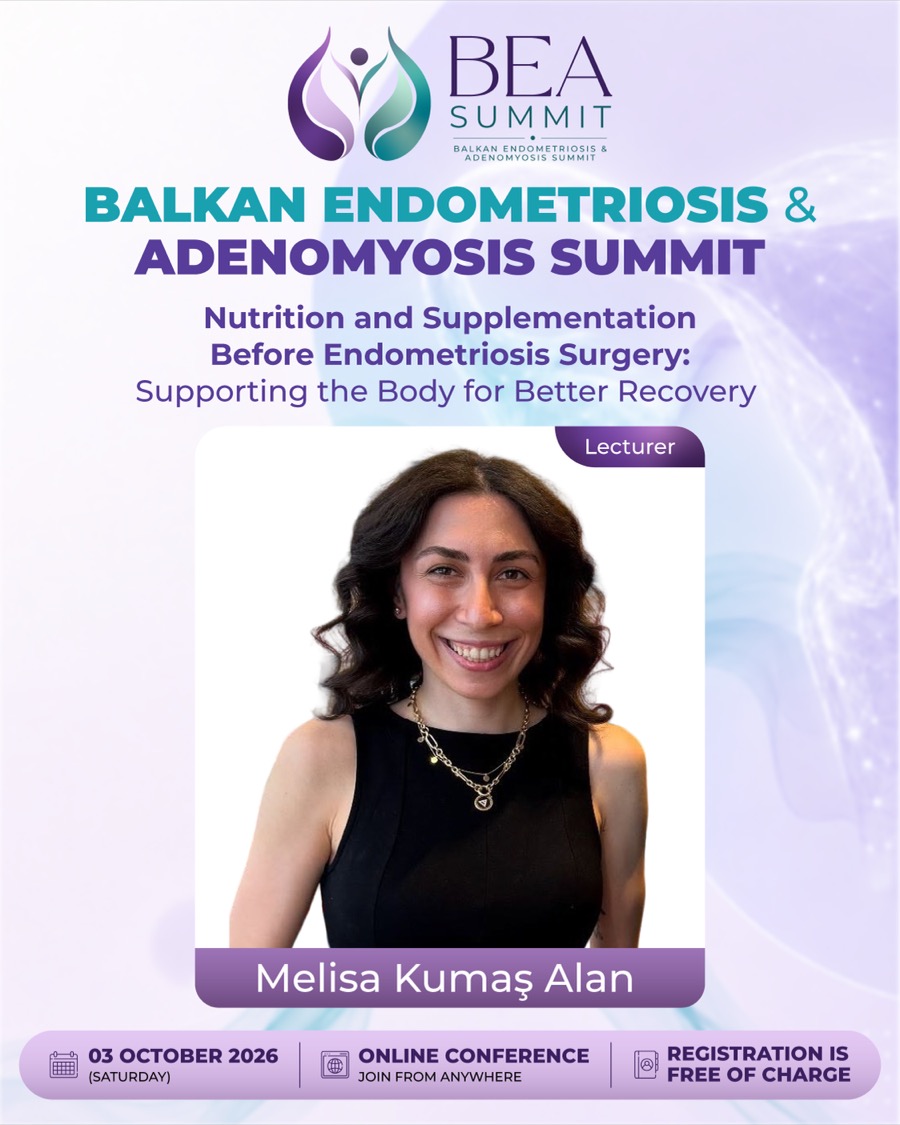
Dr. Melisa Kumaş Alan is a dietitian, author, and nutrition specialist in endometriosis and IVF, based in Istanbul. She has extensive clinical training in medical nutrition and additional certifications from leading international organizations, which enable her to stay abreast of the latest research in reproductive medicine. Her professional focus on endometriosis is deeply personal - her own diagnosis led her to develop evidence-based nutritional and lifestyle strategies to support women during treatment and recovery. She is the author of the book Part of Me and actively participates in educational initiatives, promoting the role of nutrition in preparing for surgery and postoperative recovery.
On 3 October 2026, Dr Kumaş Alan will join the Balkan Endometriosis & Adenomyosis Summit 2026 - a free, online conference in English bringing together leading specialists and patient organisations from across the region.
The conversation with Dr Kumaş Alan shows how her personal experience with endometriosis and her clinical work in a hospital setting led her to specialize in nutrition for endometriosis and IVF. She explains how evidence-based nutrition and carefully selected supplements can support recovery, reduce inflammation, and prepare the body for surgery and reproductive treatments without creating unrealistic expectations or restrictions. The interview also outlines the future of nutritional care - personalized strategies, critical thinking about supplements, and earlier involvement of dietitians in multidisciplinary teams.
Early in my career, working in a hospital environment taught me how closely nutrition is connected to overall health and recovery. But my interest in reproductive health became much more personal and profound through my own experience with endometriosis.
I began to realise that nutrition was not simply about weight or general healthy eating. It could also be about supporting inflammation, metabolic health, the gut, micronutrient status, recovery, and the body’s ability to cope with medical treatments and surgery.
As I learned more about endometriosis and fertility, I became particularly interested in the space between medical treatment and everyday life. Surgery, medication, IVF and fertility treatments are essential for many patients, but what happens around those treatments also matters. Nutrition cannot cure endometriosis or replace medical treatment, but it can be a valuable part of comprehensive care.
That is what ultimately led me to focus on endometriosis and IVF nutrition: helping patients understand what they can do, within the scope of evidence, to support their health and feel more empowered throughout their journey.
My diagnosis came after years of symptoms and uncertainty, and that experience changed the way I see patients.
When you live with unexplained symptoms for a long time, you can start questioning your own body. You may wonder whether what you are experiencing is normal, whether you are exaggerating, or whether there is simply something you should be doing differently.
Because I have experienced that uncertainty myself, I try to create a very different environment for my patients. I want them to feel heard, never blamed, and never made to believe that their condition is simply the result of not eating well enough or not having the “perfect” lifestyle.
My personal experience also taught me that there is no single endometriosis diet. Every patient has a different history, symptoms, nutritional status, lifestyle and relationship with food.
So today, I approach nutrition with both scientific curiosity and empathy. I want to give patients practical tools without adding another layer of pressure to an already difficult journey.
One of the most valuable lessons has been learning how to individualise nutritional and supplement recommendations rather than following a one-size-fits-all protocol.
Endometriosis and fertility patients are often exposed to enormous amounts of information about supplements. There are claims about antioxidants, inflammation, hormones, egg quality, implantation and fertility everywhere. Understanding the mechanisms is useful, but knowing how to critically evaluate the actual evidence is even more important.
My counseling training has also been extremely valuable because nutrition is not only about knowing what someone should eat. It is about understanding whether a recommendation is realistic for that person and whether they are psychologically ready to implement it.
With IVF patients especially, I have learned that timing, treatment protocols, medications, laboratory findings, dietary intake and individual goals all need to be considered together.
Ultimately, the most valuable skill is being able to translate scientific information into safe, realistic and personalised guidance.
One of the biggest misconceptions is that there is a specific “fertility diet” that can dramatically change the outcome of an IVF cycle in a matter of weeks.
Patients sometimes come to me believing that if they eat perfectly for one month, take enough supplements and eliminate certain foods, they can guarantee better eggs, embryos or implantation. Unfortunately, fertility is much more complex than that.
Another misconception is that more supplements are always better. They are not. Supplements can be useful when there is a clear rationale, but taking a long list of products without considering dose, interactions, nutritional status or the available evidence is not necessarily beneficial.
I also see patients becoming unnecessarily restrictive. They may remove gluten, dairy, sugar, carbohydrates, fruit or entire food groups because they have read that these foods are “bad for fertility.”
My approach is much more balanced. Preconception nutrition is about building a strong nutritional foundation: adequate energy and protein, a varied and nutrient-dense diet, sufficient key micronutrients, healthy fats, good metabolic health and sustainable lifestyle habits.
The goal is not perfection. It is preparation.
I usually start by bringing the conversation back to three questions: What is the goal? What does the evidence actually show? And is this supplement appropriate for this particular person?
A supplement can have an interesting mechanism in a laboratory study, but that does not automatically mean it improves clinical outcomes in humans. I think it is very important to distinguish between biological plausibility, observational research, clinical trials and strong clinical evidence.
I also look at the patient’s diet, blood tests, medications, medical history and fertility treatment protocol before recommending anything.
For me, evidence-based practice does not mean ignoring supplements. It means using them thoughtfully.
I want patients to understand why they are taking something, what we realistically expect it to do, what dose is appropriate, how long it may be used, and when it may not be appropriate.
Most importantly, I try to replace fear and confusion with critical thinking. Patients do not need to follow every trend they see online. They need a clear framework for deciding what is relevant to them.
My book, Part of Me, is very personal because it begins with my own experience of living with endometriosis. But I did not want it to be simply a story about illness.
I wanted readers to feel that they could move from feeling disconnected from their body to understanding it better.
One of the central ideas of the book is “to notice, transform and share.”
I wanted to show that healing is not necessarily about finding one magical solution. It can be a process of learning about your body, making sustainable changes, seeking the right medical support and becoming an active participant in your own healthcare.
And perhaps most importantly, I wanted anyone living with endometriosis to feel less alone.
My story is not a promise that nutrition will cure the disease. It is a reminder that even when we cannot control everything about a condition, there are still meaningful things we can do to support ourselves.
The goal of preoperative nutrition is not to put someone on a restrictive “endometriosis diet” before surgery. It is to make sure the body is adequately nourished and in the best possible condition to face the physiological stress of surgery.
I think about several areas: adequate protein and energy intake, micronutrient status, iron and haemoglobin when relevant, hydration, digestive health, and an overall nutrient-dense dietary pattern.
In complex endometriosis cases, patients may also have years of pain, restrictive eating patterns, gastrointestinal symptoms, fatigue or previous nutritional deficiencies. These factors need to be considered individually.
Another important goal is setting realistic expectations. I don't believe in trying to “detox” the body before surgery or using aggressive elimination diets. Instead, I want to build nutritional resilience.
The period before surgery is an opportunity to prepare the body, but also to prepare the patient. Good nutrition should support recovery—not become another source of stress.
I believe the future is increasingly multidisciplinary.
Endometriosis and infertility are complex conditions, and no single healthcare professional can address every aspect of a patient’s experience. I see nutrition becoming more integrated into care alongside gynaecologists, reproductive endocrinologists, surgeons, psychologists, physiotherapists and other specialists.
But I also think we need to be careful about how we communicate the role of lifestyle medicine. There is a growing interest in nutrition, which is positive, but it can also create unrealistic expectations. Patients should never be told that lifestyle changes can replace appropriate medical treatment.
The future I would like to see is one where nutrition is neither dismissed nor exaggerated.
We should use evidence to identify where nutrition can genuinely help—whether that is supporting nutritional adequacy, metabolic health, symptom management, preparation for surgery or fertility treatment, or recovery—and integrate those interventions into personalised care.
Ultimately, I would like nutrition to become a standard supportive component of reproductive and endometriosis care, while keeping the patient at the centre of everything we do.
Register free to attend Melisa Kumaş Alan, RD’s session and the full BEA Summit 2026 programme.
Register Now