 BEA Summit is Live
BEA Summit is Live
BEA Summit is Live
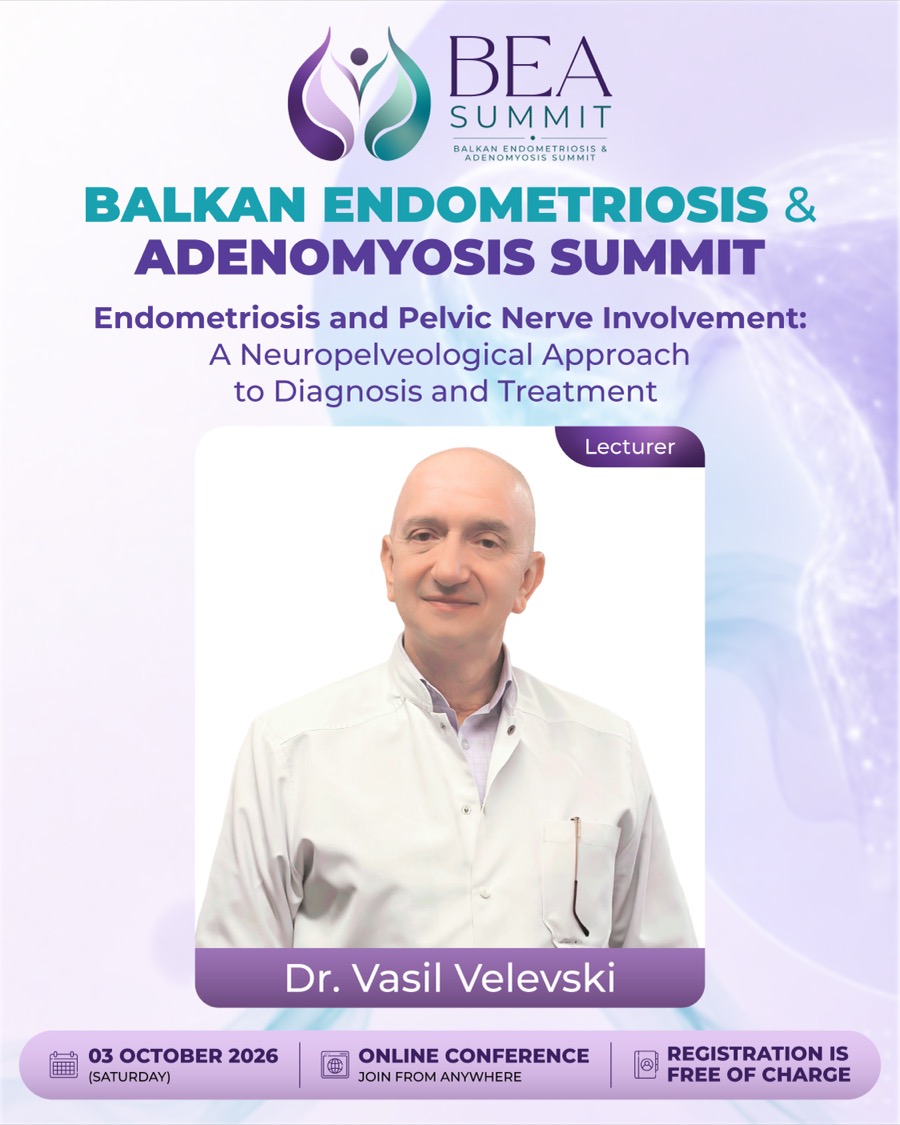
Dr Vasil Velevski is an obstetrician-gynecologist with over 30 years of clinical experience and many years of specialization in endometriosis, laparoscopic surgery, and pelvic nerve disorders. He works at the Center for Endometriosis and Neuropelvology at AG Centre Europe in Plovdiv and heads the gynecology department at the Beroe Medical Complex. His career spans over 25 years of experience in laparoscopic and gynecologic oncology surgery, as well as international training in France, Italy, Belgium, and India, followed by advanced training in neuropelviology under the guidance of Prof. Marc Possover. His work focuses on the identification of neuropathic pain in endometriosis and the role of pelvic nerves in complex cases, and he actively promotes this still-emerging field among patients and clinicians in Bulgaria.
On 3 October 2026, Dr Velevski will join the Balkan Endometriosis & Adenomyosis Summit 2026 - a free, online conference in English bringing together leading specialists and patient organisations from across the region.
The interview with Dr. Vasil Velevski shows how his thirty years of clinical experience and the development of modern laparoscopy have changed his understanding of endometriosis, revealing the true extent of the disease and its connection to the pelvic organs. He explains why neuropelviology is key to diagnosing neuropathic pain, how small lesions can cause severe symptoms, and why precise dissection of the pelvic nerves is critical in complex surgery. The interview outlines the future of treatment—better protection of nerve structures, multidisciplinary teams, and the introduction of robotics and nerve implants for managing chronic pelvic pain.
Thanks to the rapid development and implementation of new technologies in medicine, knowledge is increasing many times over.
At the beginning of my career, much of the knowledge about the disease was different. With the development of imaging diagnostics and endoscopic surgery, our knowledge about this complex gynecological condition increased. The spread of the disease in all organs and in the pelvis became visible. Many of the symptoms that we attribute to other diseases found their explanation and therapy in the disease.
Endometriosis is a complex disease and its spread to the pelvis and organs outside it is always associated with a change in the innervation and function of the affected organs. Without perfect knowledge of the anatomy and proper dissection of the pelvic nerves, the organs and their function are damaged.
Sometimes small lesions cause severe pain. This is associated with direct damage and growth of the disease within the somatic nerves themselves. Therefore, it is possible to have a very severe pain syndrome and almost no objective findings. This is why the physician needs to know which nerve is affected and actively search for the disease. The symptoms are severe burning, shooting pain. Patients describe it as if an electric current is passing through. They also mention difficulty moving the limbs and loss of muscle mass.
From my multiple specializations, I realized that two things are important: First - correct knowledge and accurate diagnosis of endometriosis in all its forms. Second - daily dedication to the profession.
In all surgical techniques and schools, the most important thing is the correct and accurate diagnosis of Endometriosis. Currently, there is a worldwide consensus regarding the surgical treatment of deep endometriosis - the most accurate anatomical excision of the endometriotic focus, while maximally preserving the size and function of the pelvic nerves and preserving the function of the affected organs - bladder, intestines, diaphragm, etc. In this approach, a multidisciplinary team is mandatory.
The training completely changed my way and approach to treating patients with pelvic pain. The daily treatment of these patients requires continuous training, taking responsibility, as well as long-term post-operative monitoring and care of the patients.
When examining a patient with endometriosis, in whom there are suspicions of involvement of the pelvic nerves, the latter are examined palpatingly, functionally, and in the case of somatic nerves, sensitivity and reflex are also examined.
Unfortunately, most imaging specialists are still not sufficiently familiar with this area, and this requires the specialists in surgery and gynecology themselves to specialize in the interpretation of imaging diagnostics.
Postoperative monitoring of the operated organs and their functions is very important.
The severity of symptoms is individual and depends primarily not on the size, but on the depth of invasion of the pelvic nerves, as well as on the degree of nerve excitation. The signs of somatic and vegetative pain are fundamentally different and cannot be described briefly.
The description of neuropathic pain is different and depends on the type of nervous system that is affected. When the autonomic nervous system is affected, the pain is weak, indefinite, dull and almost constant. There are autonomic symptoms, there is dysfunction of the bladder and rectum.
When the somatic nervous system is affected, the pain is strong, burning and there are disturbances in the function of the affected organ/muscle/. The pain is always at the end of the nerve, i.e. on the skin.
The basis of proper surgical therapy is a good knowledge of the pelvic retroperitoneal anatomy, as well as the correct use of modern endoscopic equipment, which allows for good visualization and dissection of the pelvic structures. Proper treatment of the tissues prevents postoperative changes in the pelvic nerves.
With good anatomical orientation and good surgical technique of the team, the disease should be dissected down to healthy tissues and the surrounding structures should be preserved to the maximum extent. However, if the disease has affected part of the nerve, this part should be removed and restorative procedures should be performed postoperatively. However, two identical nerves should never be operated on. First one and then the other.
The challenges are great and are related to misunderstanding and sometimes lack of familiarity of the disease endometriosis. Ignorance of the etiology of pelvic pain, insufficient training of young colleagues and last but not least, underfunding of these diseases by the health system leads to inadequate and incorrect treatment of patients. Treating endometriosis in all its forms requires a comprehensive approach and a team of different specialists who understand and are committed to this complex disease.
Therapy requires a multidisciplinary team, the creation of which is a long and laborious process. Long and continuous training of the team and constant contact between its members are necessary. It is important that young colleagues are trained in these teams. Both they and the entire team are motivated and financially supported. It is necessary for the health insurance company to separate the disease endometriosis into a separate clinical pathway and the funding to be determined by the volume of the surgical intervention and the number of affected extragenital organs.
Treatment should be carried out after the most accurate and precise diagnosis. The size of the endometriosis and its distribution should be specified in advance.
The functions of the affected organs should be specified - bladder, intestines, pelvic nerves, diaphragm, lungs, etc. During surgical therapy, use of high-tech endoscopic equipment 4k and 3D in order to distinguish healthy from affected tissue as well as possible.
If necessary, the team should always include physicians from other specialties who also participate in postoperative follow-up.
In neuropelvеology, a massive penetration of robotic surgery is expected for better selection and dissection of the pelvic nerves. In chronic neuropathic pain in the small pelvis, pelvic nerve protectors can be implanted LION-procedure-laparoscopic implantation of nerve prostheses. This procedure is a selective placement of electrons in certain nerves /pudendal, femoral, sciatic and others/ for the purpose of stimulation and therapy.
Register free to attend Dr. Vasil Velevski’s session and the full BEA Summit 2026 programme.
Register Now